Fairhaven Sermon 5-3-2026
Summary
In this week’s service, Rev. Dylan Parson explores the profound tension within John 14, a passage set during the Last Supper where Jesus prepares his disciples for his impending betrayal and death. While this scripture is a staple of funeral liturgies—offering deep comfort to those mourning recent losses in the Fairhaven community—Rev. Parson notes that the text is much more than a promise of a heavenly destination. Rather than presenting a static end-point, the sermon highlights that Jesus’ words describe a dynamic way of being and a continuous, unfolding journey of faith.
Moving beyond the traditional imagery of "many mansions" as grand, permanent estates, Rev. Parson delves into the Greek concept of monē, suggesting that these dwelling places are more akin to "base camps" for an ongoing adventure. He introduces the theological concept of epictasis, or the "stretching forward" toward God, illustrating that eternity is not a state of idle rest, but an endless exploration of God's greatness. Using the metaphor of climbing a mountain, Rev. Parson concludes that as we follow Jesus—the Way, the Truth, and the Life—we discover that the view only grows more breathtaking the further we ascend, inviting us to find rest in Him even as we continue our upward climb.
Transcript
This morning's gospel text, we're in John now, puts us in this disorienting position. We're reading John 14 here in the Easter season, so we're celebrating Jesus' triumphant resurrection. We're celebrating these 50 days where he's among the disciples again, but this passage is comes from what is known by biblical scholars as Jesus' farewell discourse. And he's not saying farewell because he's about to ascend victoriously into heaven. He's saying farewell because what is being spoken here in John 14, he's sharing with them at the Last Supper. This, again, is not a "Hey, don't worry guys, I'm going to heaven" message. This is an "I am about to be betrayed and killed" message. This is kind of a rewind here. We're in the season of white cloth and daffodils, but this is taking us back to purple. We're flinching, we're confused as he's hours away from being led away in chains. This is actually right exactly where our reading left off on Maundy Thursday. This is a Holy Week text. So whenever you hear what John is $\text{is}$ saying to us today, this is the context.
As Jesus speaks, he is preparing the disciples for the very worst days of their lives, which are barreling down the tracks at them. It's Good Friday the next day after this is spoken. And so it's no surprise that this John 14, excerpts from it at least, has become the standard reading for funerals. The same way that you always hear, almost always, 1 Corinthians 13, love is patient, love is kind at weddings. This is the funeral text. Whenever I open up the book of worship and start to pray at the beginning of a funeral service, two pages later comes John 14, the passage we've just heard. Flo read from the NRSV, and I find myself, I can pretty much recite that now. And it's only one of a few possible gospel readings, but it's also the $\text{only}$ one that's printed in its entirety in the book. So it's kind of expected that you're going to use it. And if I'm the pastor presiding and the person has not requested a different passage, this is almost certainly what you're going to get as a funeral passage.
message. And it's been a very hard month for Fairhaven and for Spencer. We've had a number of deaths. And so this month, I have probably already preached on John 14 four or five times. And maybe some of you have been there, as I have. We had Robin's memorial service last Sunday. And it's perfect for the occasion. It really is the perfect funeral text. Jesus is speaking of the promise of hope in the midst of gathering darkness. Death is looming. It's weighing heavily on everyone in the room. The betrayal is on the way. And he is about to be the lost loved one for whom a funeral is mourning while he's also seemingly speaking to those who die. Bye.
And Jesus promises, in the way the CEB puts it, "...my father's house has room to spare." Or as we just heard, in my father's house there are many dwelling places. Or even older, the King James that you might be familiar with, in my father's house there are many mansions. And he has gone to prepare a place for those who will be joining him. And we find a lot of comfort in this promise, don't we? This is a great thing to hear in the midst of death. It means so much to know that our beloved friends, our family members, our spouses, others who have died are going to the place where Jesus has gone, living in the Father's own house in a home prepared especially for them. And the way Jesus tells it, this is not some big generic place. But he prepares a special place for us, something that is ours in a special way. And we need to and hear that those who are gone from our sight are not truly gone. They're just away from us for the time being.
And Jesus says that we know the way to the place that they are going. And so we're reassured. But, we don't get a lot of opportunity, I know I don't, to think about what Jesus' farewell discourse here in John 14 means for us, the living. Those of us who are not imminently expecting to arrive at the place Jesus has prepared for us. And I went back, I went and looked over my sermons from the past ten years, and I'm fairly sure that I've never gotten to preach this half of John 14 without a casket or an urn in the room. So, what does it mean to us here, on a Sunday morning, when we still have air in our lungs, when we've got years of life ahead of us? What does John 14 mean in this context? There's just so much here. What does John 14 mean in this context?
Jesus' words of promise in John 14 are hope not just for the destination of where we're going to dwell in the end, but I think that Jesus is talking equally, if not more so, about a journey. Jesus is describing a way of being, a way of living for his disciples, which includes us as well as Philip and Thomas and all of them. He's describing this way of being that's dynamic, that's filled with power, that's endlessly unfolding into something new. And Thomas, in his doubt, reflects the way that we are so prone to limit what Jesus is promising. Thomas asks, "Lord, we don't know where you're going." How can we know the way? He is doubting himself. He's doubting the message that Jesus has given him. Thomas is able, but he doesn't know. And he's asking for the exact coordinates. Jesus, where are you going? Where exactly are you headed on the other side of the cross? And Thomas wants to step-by-step map quest instructions. He wants turn-by-turn directions. Go here, then go left, then do this, and then continue on, and you'll finally be there. The journey is over. That's what Thomas wants. And without this kind of map quest, triptych thing, how could we possibly get to where we're supposed to $\text{go?}$ Thomas doesn't believe that he can get there without Jesus telling him how. But that's not the kind of destination that Jesus is describing here. Right?
And that is where his gentle response from Thomas comes from. Jesus says, I am the way, the truth, and the life. No one comes to the Father except through me. So sit with that for a minute here. Jesus makes clear that he's not the one who gives us directions. He himself is the direction. He is the way. He's not the one who tells us, explains to us what's true and what's false. He is himself the truth. And he's not the one who tells us how to live our lives. He is the life that we're supposed to live. Do you see the difference there? There's no possible step-by-step directions to be a disciple of Jesus, to journey with him toward the Father. The only option that he's giving here is to trust in him. Follow Him to be the way that He was and is. That's the direction. There's not some street address at the end that we can point our compasses toward. There's only the way there. And it unfolds in front of us as we get closer and closer and closer.
There is no clear map. There's no timeline. And this can feel so frustrating, but is so typical of how Jesus is constantly teaching and leading and pastoring in the Gospels. We are never given rules for living in black and white. Do this. Don't do this. Go this way. Don't go this way. And instead, we're constantly invited by Jesus to follow, to figure it out on the way. And what's crucial here is that indeed what Jesus is describing is a path. And it's a unique kind of path. Again, not this simple line from point A to point B, start here, end up here. There was a great Christian civil rights leader named Miles Horton, and he famously said, "...we make the road by walking." And that thought he himself translated from a Spanish poet named Antonio Machado. And Machado wrote, this is the poem, Wanderer, your footsteps are the road and nothing more. Wanderer, there is no road. The road is made by walking. By walking, one makes the road, and upon glancing behind, one sees the path that never will be trod again. Wanderer, there is no road, only wakes upon the sea. And I imagine... that this is not very satisfying to Thomas.
Thomas wants an answer. And this is frustrating to us as well, because a route that we make by walking, I don't know how often you've walked in the woods. I was a big woods hiker as a kid, spent my days plowing through the thorns and the trees. That takes a lot more trust in where you're going than following some asphalt pavement. But it's a promise of something deeper. It's a deep life with and in God who is beyond our understanding, this invitation to keep coming closer and closer. Right?
And to push this a little bit further even still... I think that Jesus is offering us the promise that this is eternal, that God's greatness will continue unfolding in front of us, will continue exploring all that God has for us forever. And again, as we consider this passage from John in the context of a funeral, we hear it a little bit different. You know, we tend to think of the spare room, of the dwelling places Jesus describes preparing for us as something like a hotel room. It sounds like something that we arrive at after this long, grueling road trip. We're exhausted. We drop our bags at the door and we flop onto the bed. That's what that dwelling place must be like when we hear this at a funeral. We're finally there. That's that. End of the road. We've got there.
But our imagination is a little bit limited, I think, thinking about it that $\text{way.}$ And part of that problem, I think, is that we've heard it forever as, in my father's house there are many mansions. We each picture this big, beautiful house that's been prepared for us with towers and a big lawn and gardens. But mansions in King James English just meant kind of lodging. It meant a room. A mansion back then was not a mansion now. And the Greek word that's used here, monē, definitely did not mean anything like we think about a mansion. The room that Jesus is describing, the dwelling place that he's preparing for us, carries this connotation, in Greek, of a place where a traveler rests or abides along a road in a journey. It's not this sedentary life of living in some castle-like mansion by ourselves. Right? It's not the temporary rest of a motel. It's almost like a base camp is what's being described. This place from which we continue our journey with Jesus.
We have this place to dwell, but we're still continuing our $\text{journey with Jesus.}$ Something that always scared me when I was younger, when I would think about heaven, when I'd think about dying, was the prospect of just sort of being there forever. You kind of get an existential crisis when you think about that. It's like looking out at the ocean and realizing that it just goes on. And the concept of eternity is really scary, especially if we start imagining cabin fever just on an eternal scale, millions of years of cabin fever in heaven. But Jesus is not describing something like that. He's describing this just ongoing life and the places he prepares for us as dwelling places along a journey that keeps going from which we continue on the way, the truth, the life. We get closer and closer to Jesus and God forever. There's always more to do. These are words here, way, truth, life, that describe motion and movement and evolution and adventure. And again, we're not following Jesus to our room in some big old retirement condo in the sky. That's not what's happening here, but to a place where we continue to live and grow alongside him with each other.
And we use, again, Psalm 84, another funeral text here. Psalm 84 describes us as going from strength to strength until we see the supreme God in Zion. We're not headed to a heaven that's boring, where every day is exactly the same for the rest of eternity, but a resurrection into a new heaven, into a new earth where every day is new. The end of one discovery that we make in God is the beginning of the next one. We just have this endless frontier before us. The word for this idea, this concept of what eternity is like, was first described by some of the earliest Christian writers, the first couple hundred years of the church. One of those was St. Gregory of Nyssa. And he called this epictasis, epictasis. And that means straining forward or stretching out. Think of heaven as stretching out, as spreading your wings. This constant reaching closer and closer to everything that God is. And it's a process that we live into on either side of death. We start on the way as we follow Jesus now. We stretch out, we strain forward as we get to know Jesus now, as we continue to follow him now and into eternity. It's this never-ending climb into the heart of God, like loving somebody you get to know better and better and better every day.
And Jesus says no one gets to the Father except through him, right? And this then is what going through him looks like, the way, the truth, the life. When this earthly life ends, we arrive at home in what Jesus calls the place where I am going. Not because we've reached an end point, this place where we stop moving, but because we finally fully end up next to Jesus, abiding in Jesus on the way that continues. We leave behind sin, we leave behind weakness, disease, doubt, and we move in pure love with Him. All the stuff that's held us back is left behind and we're free to walk with Him. John Wesley called this "moving onward to perfection." And so, Methodists have always insisted that this journey begins for us. Amen. The moment that we decide to follow Jesus, we are entering into the path to the place where He has gone. And the specific coordinates of the destination, they're not important, we can't even figure them out. The important part is that we're following Jesus on the way there.
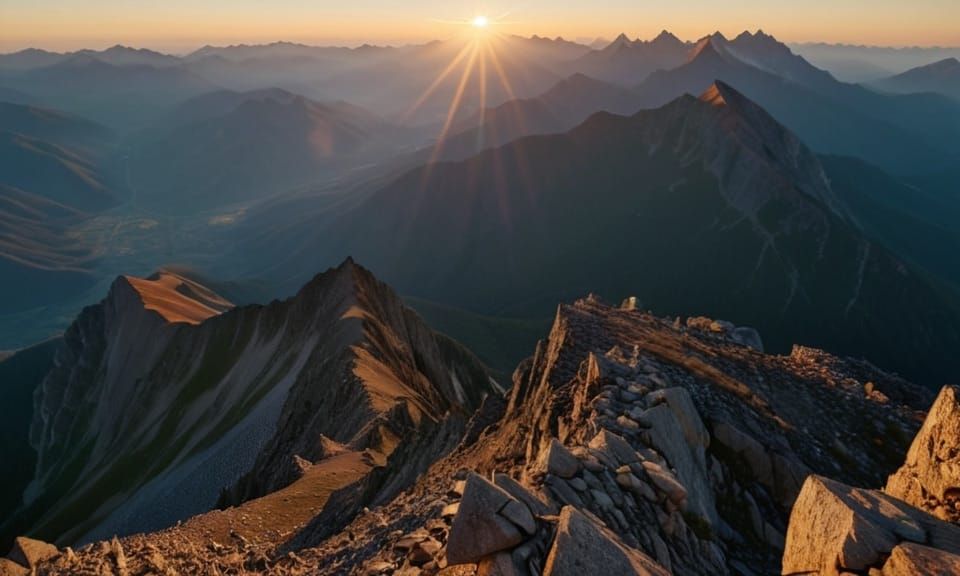
I don't know how many of you have ever climbed a mountain, not in a car, but on foot, like actually walked up a mountain. But every single time I've done that, whether it's been in the North Carolina Blue Ridge, the Green Mountains of Vermont, the Alleghenies in West Virginia, every time I've climbed a mountain, there's always been some breathtaking view long before you hit the top, sometimes only halfway up, even less. And every time I stop for a few minutes, I sit on a rock, look out, you can see the hawks circling below you, you can see the mountain ridges going off onto the horizon. And so every time you get to this first vista, breathing hard with my knees already aching, there's always this temptation there to say, ah, this is good enough, and turn around.
But something else happens almost every single time. And, you know, I'm going to go to the next step. It's amazing because I think it does happen every time. While I'm sitting there, someone who's already been to the summit, passing by as they make their way back to the parking lot, will stop and say that the view at the peak is so much better still. That is what Jesus is talking about here. Still. When he assures them that they know the way to the place where he is going, "Follow my footsteps. Keep walking up this great mountain. We're making this road by walking it together." And those who have gone ahead of us, those who have died, not to mention Jesus himself, have seen a view beyond what we can imagine. One that awaits us as we move closer to the top. So do not let your hearts be $\text{troubled, he says.}$ Jesus is the way. And we can find complete rest in him even as we keep climbing into eternity. In the name of the Father and the Son and the Holy Spirit. Amen.