Fairhaven Sermon 3-8-2026
Summary
In this week’s service, Rev. Peg Bowman continued the Lenten sermon series on spiritual health, focusing on the vital sign of "hydration." Drawing on a definition from Google AI, she explained spiritual thirst as a profound longing for purpose, meaning, and connection with the divine – a craving that can be quenched through prayer, scripture reading, and righteousness. The sermon explored this concept through readings from Exodus, Psalms, and the Gospel of John, emphasizing the importance of trusting God and recognizing His provision, even when faced with hardship and doubt.
The heart of the message centered on Jesus’ encounter with a Samaritan woman at a well (John 4), highlighting his willingness to bridge social and religious divides and offer "living water" – a metaphor for spiritual fulfillment. Rev. Bowman emphasized the radical nature of this interaction, where Jesus challenged prejudice, revealed truth, and ultimately, found nourishment in sharing God's love. The sermon concluded with a call to action, encouraging the congregation to extend compassion and welcome to those in need, mirroring Jesus’ example and offering them a chance to quench their own spiritual thirst.
Transcript
Welcome to week three of our Lenten sermon series on vital signs. This week's spiritual health topic is on staying hydrated. We know how important it is physically to drink enough water every day. We know if we go out running or walking or take part in a sport that we need to take water with us.
We also know that a person can only last about three days without water, and that's assuming it's not hot out. On a spiritual level, though, what is it that keeps us spiritually hydrated, and what does it mean to be spiritually thirsty? Well, Now, I'm no fan of AI, but every now and then Google AI comes up with something that's not too bad. I asked Google, what is spiritual thirst? I was just curious what it would come up with. Here's the answer it gave me.
Spiritual thirst is a profound, innate longing of the human soul for purpose, meaning, and connection with the divine, often described as a deep craving that transcends material satisfaction. Symbolizing a need for God, this inner dryness or soul dehydration is frequently quenched through prayer, reading scripture, and the pursuit of righteousness. Not bad for a machine, right? Not bad. So the opposite of spiritual thirst could be described as joy or the assurance of God's presence and care.
And Isaiah 12.3 says, ...
with joy you will draw water from the wells of salvation. So when we think about life, we want our lives to have meaning, to go on beyond the short number of years that we have on this planet, and this also is a kind of spiritual thirst. Each of our scripture readings for today, from Exodus, Psalms, and the Gospel of John, each one talks about thirst in one form or another. In our reading from Exodus, we read about actual physical thirst— Psalm 95 revisits the events in Exodus, and the Gospel of John, we listen in on a conversation next to a well.
Now, I wanted to spend the bulk of our time today with that conversation at the well, but the other two readings have important things in them that I don't want to miss, so we'll start with that and then move through into the big story. So, starting in Exodus, the people of Israel...
We're set free from slavery in Egypt not long before the events of this particular reading. They are now on their way to the Promised Land, but they have a ways to go yet. And at this point, they are not too far from Mount Sinai, which tells us they don't have the Ten Commandments yet. Their journey so far has been long, and it has not been easy, and the people have been grumbling the whole way.
And at this point, they have set up camp at a place called Rafirim, which means place of rest, and it's anything but restful. Okay. Immediately, the people start complaining that there's no water. Now, this raises all kinds of questions that the Bible does not answer, questions like, is there really no water nearby? Did they actually look? Why would Moses stop in a place where there's no water? Why do the people not dig a well? What exactly were people expecting Moses to do about the lack of water? We don't have answers to these questions.
What's clear is that the people expect Moses to do something. And Moses comes to God and says, They're about to stone me. What should I do? God's answer indicates that the people are showing a lack of faith. After all the miracles that they've witnessed, they're still doubting God's presence.
They doubt God's care. They doubt God's ability to provide. And God is not happy about this. Scripture says that the people were testing the Lord, and they were certainly testing Moses.
So God tells Moses to take his staff and take a few of the elders and go to the rock at Horeb, which, by the way, is another name for Sinai. So it was within a day's journey of the Mount of Sinai. And he says, Little side note, Horeb was also the location where Moses saw the burning bush all those years before. So, Moses strikes the rock, and water comes out, and the people have all the water they need, and Moses names the place Massa and Meribah, which means testing and quarreling.
So, So what does this mean for us? There are a number of ways we could apply this information, just to name a few. When people test God and quarrel with God, it might be an indication that God's people need to work on their ability to trust, because God is infinitely trustworthy, and God's people don't need to be afraid. It might be an indication that God's people need to work on their ability not so much to love as to receive love— And we see this frequently just as an example in people who are caught in addictions. Deep down, they don't think they're worthy of love, which of course isn't true, but it makes it tough to reach them.
It may be an indication that God's people need to get to know God better because God does care for us. God can never stop loving because God is love in the same way that water is wet, right? God's love doesn't depend on us because God's love is God's nature. And so these are some of the things that the people of Israel were wrestling with as they traveled through the wilderness to the Promised Land. During this time, they needed to learn that God hears and God cares and God knows what we need and God will act and God will provide.
That's from Exodus. From Psalm 95, just want to mention briefly, Psalm 95 says that God is the rock of our salvation, verse 1, which echoes the events at Massa and Meribah. God is the source of water. God is the source of all we need, and we are called to worship.
This psalm reminds us not to harden our hearts as the people did in the desert when life gets tough. but to keep our hearts soft towards God and our minds and our ears open. Amen. Psalm 95 also, just as an aside, is a very important psalm in the history of the church.
For the liturgical churches, Catholic, Orthodox, Lutheran, Anglican, Episcopalian, this psalm is a part of their daily prayer service. And it's not foreign to the Methodist Church either. It's John Wesley practiced daily prayer, and the daily prayer service that's in the back of our hymnal on page 877 mentions Psalm 95. So this is very much a part of our tradition and the part of church tradition for the past thousand years.
And history like this, in my opinion, is too important to ignore. So I recommend this Psalm 95 to you for personal prayer time, as it has been used down through the centuries. But last and certainly not least, we come to the Gospel of John. chapter 4.
And this is one of my favorite passages in all of Scripture. I love this conversation between Jesus and a Samaritan woman. I love who Jesus is when he's talking with her, and I love who she is when she's talking with him. And today, as we're talking about hydration and thirst, we meet at this well two people who are thirsty—the Jesus is thirsty for water, but he's also thirsty to be known for who he really is.
And the woman, whose name we don't know, is thirsty for friendship and respect, and also to be known for who she really is. Before we listen into this conversation, just a little bit by way of background, Jesus and the disciples have been traveling from the northern part of Israel to Jerusalem in the south, and at this point in their journey they're about halfway there. Jesus has told the disciples he'd like to rest, and he has given them an assignment to walk into the nearby town and get lunch. The Samaritan woman, like all Samaritans, was a descendant of generations of intermarriage between the Jewish people who were left behind when the Babylonians came and took them all captive.
They were the ones left behind. Marriage between them and Gentile Assyrians who invaded from the north. So, they were, at best, as they were considered, like half-breeds by the Jewish people, and that comes with all of the cultural, religious, and racial prejudice that you can imagine. And needless to say, the events in this story would have been a total scandal in Jesus' day, because Jews didn't talk to Samaritans, and Samaritans didn't talk to Jews.
And nice men back then didn't talk to nice women in public, no matter where they were from. So this conversation breaks all the rules. Or we could say this conversation shows us how to build bridges in places where people say bridges shouldn't be built. Let's listen in.
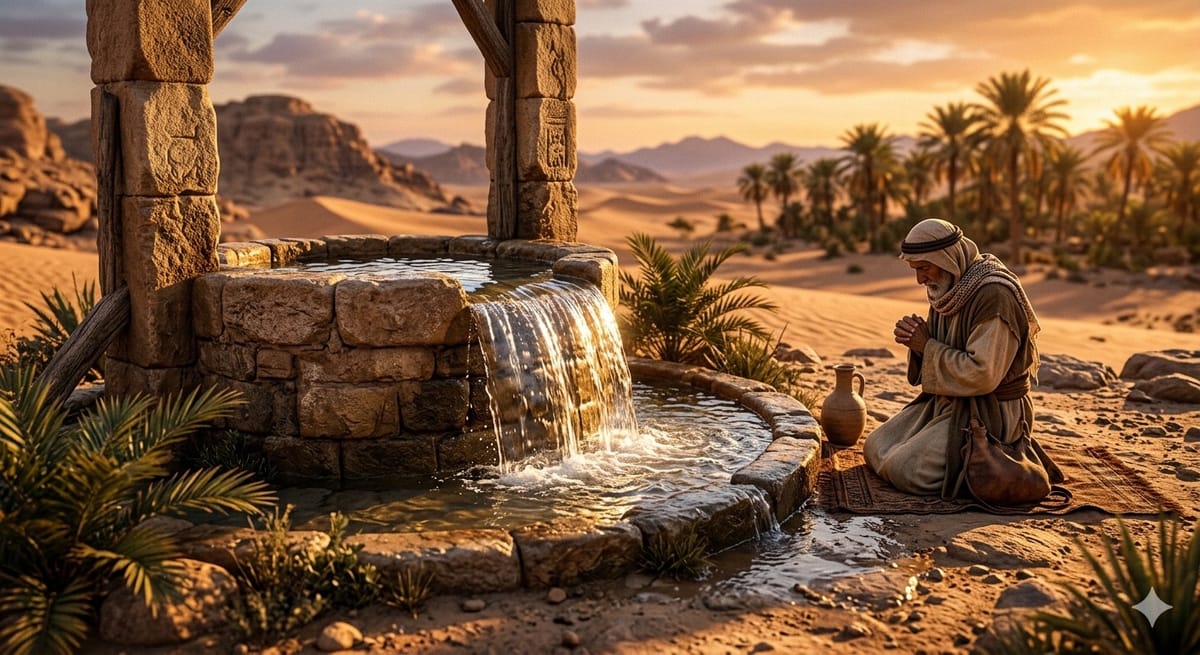
Jesus is sitting by a well, resting. And this well is located on a mountainside near Samaria. It's a very old well. It's almost noontime.
And while Jesus is resting, a woman comes along carrying a water jug. Now, Jesus immediately knows that something's wrong because women don't come to wells at noon or alone alone. Women of the village come to get water early in the morning before it gets hot, and they travel together for protection. A woman traveling alone is unprotected.
So when she sees a man sitting at the well, she's immediately on alert. This situation could be dangerous, and every woman, even today, knows this feeling when you're in a strange situation with an unknown man. Jesus breaks the ice by asking her, May I have a drink? And she asks him, How can you, a Jew, ask me, a Samaritan, for a drink? Because Jews and Samaritans don't share cups. They don't share anything.
No plates, no houses, they don't share food. They don't...
it's simply not done. And Jesus answers, If you knew God's gift and who it is that's talking to you, you would ask him for a drink of living water. Now, there's a double meaning in Jesus' words here: living water as in spiritual water and living water as in running water, like what you find in a creek or a river, not in a well. Running water is fresher and better tasting than well water because it's naturally filtered.
And she answers him, 'Sir, you have no bucket.' Now, Jesus has said something of interest, at least if it's maybe a little bit ridiculous in her eyes, but she's starting to think he might not be a danger. He might be a little crazy, maybe, but he's not a danger. And when she says, 'Sir,' the word is Kyrie, as in Kyrie eleison, as in Lord have mercy.
And she continues, Lord, sir, you have no bucket, and the well is deep. Where are you going to get living water? Are you greater than our ancestor Jacob, who dug this well and watered his flocks with it? See, she knows her history. Jacob was here once on that very spot, and his 12 sons who started the 12 tribes of Israel, they are the men who dug this well. And that's important to her.
And the truth is important to her. Truth is important to Jesus, too, so he says to her, Go call your husband and come back. See, Jesus already knew what her truth was, but there's no way she could have known that. And her words cut like a knife, his words cut like a knife.
She's probably thinking to herself, why did he have to bring that up? Aren't I good enough to talk to? What am I, chopped liver? She's ticked off now. And she spits out her answer in Greek: Uk eko andra. Don't have a man. And she doesn't say kyrie this time.
And Jesus answers, 'Well said.' 'Truth is, you've had five husbands, 'and the man you have now isn't your husband.' 'And he says this not unkindly, 'and he doesn't walk away.' And she answers, Kiryeh, I can see that you're a prophet.
Tell me, our ancestors worshipped on this mountain, but you Jews say the place to worship is in Jerusalem. Which by the way was true, and it was a major cause of dispute between the two nations. Jesus honors her with a complete and theologically sound response worthy of a professional religious leader. He says, The time is coming and is now here.
when people will worship God in spirit and in truth. But know that salvation is from the Jews. We worship what we know. You worship what you don't know.
But God is a spirit. And those who worship God worship in spirit and in truth. And she gets it. And she starts to wonder about him.
And so she needs to ask. She says, I know Messiah is coming. When he comes, he will teach us all things. And Jesus answers, I am he.
I am he. By the way, those are the exact same words that God said to Moses at the burning bush when Moses asked God what God's name is. I am he. And she believes him.
And as a result, Jesus' first evangelist will be a woman. Amen. At just that moment, the disciples return and they are boggled to find Jesus in a conversation with a strange Samaritan woman, but they don't ask any questions. She takes off for the village down below, leaving her water jar behind, and she says to the people of the town, 'Come see a man who told me everything I've ever done.
Could this be the Messiah?' And the whole town heads up the hill to meet Jesus. Meanwhile, the disciples are saying to Jesus, eat, eat, and Jesus says, I have food to eat that you don't know about. It's called doing the will of him who sent me. And like Jesus, when we are in the center of God's will, doing what God created us to do, and being who God created us to be.
Physical food loses its importance. Athletes experience this. So do musicians and actors and others who perform for a living. Don't really need to eat right now because this is spiritual food.
This is spiritual hydration. This is what satisfies Jesus, to see the Samaritans coming up the hill to meet him, to see them coming to believe in a God who loves them. And Jesus comments, he says, look, the fields are white under the harvest, and he's probably looking at the white turbans on all the guys' heads as they were coming up the hill. The social barriers have come down.
The prejudice and hatred are gone. And Jesus and the disciples will stay in Samaria for two more days, which is completely not right in the eyes of the Jewish people. The old ways are over. It is no longer us versus them, but it's all God's children together.
And this is what satisfies the thirst of our Lord and the thirst of the people who love him. Which leaves us with the questions. Which strangers do we see around us who we can welcome? How can we help knock down the walls of prejudice in our own day? How might we offer someone a hand up? It all begins with having that conversation with Jesus. We live in a world right now that is dying of thirst.
Thirst for truth. Thirst for God's love. Thirst for peace and for unity. Thirst for compassion.
Jesus is waiting for us at the well. Who can we invite to come? - Amen.