Fairhaven Sermon 2-8-2026
Summary
n this week’s service, Rev. Peg Bowman explored the season of Epiphany and the importance of understanding Jesus as a person, not just a historical figure destined for the cross. She emphasized the value of getting to know Jesus in the same way his early disciples – fishermen like Peter, Andrew, James, and John – did: through shared meals, community involvement, and observing his care for others. Bowman illustrated this by highlighting the recent story of a Texas judge who included Scripture verses in a court order concerning a young boy, demonstrating a "salty" way to point others towards faith and truth.
Bowman then delved into the Sermon on the Mount, focusing on Jesus’ call for followers to be “the salt of the earth” and “the light of the world.” She explained that "salty" signifies not just preservation, but also being impactful and truthful. Connecting this to Isaiah’s prophecy of restoration and rebuilding, Bowman challenged the congregation to live out God's love, be restorers in their communities, and to strive for better, embracing the hope and promise of God’s love through Jesus.
Transcript
Well, good morning again. This morning we are still, at least for another week and a half, still in the season of Epiphany, the revealing of Jesus to the world. And I was really hoping that we could take some time between Christmas and Lent to to get to know Jesus as a person, what he was like before he was famous, back when he was hanging out with the fishermen and preaching in local synagogues. But here we are only a week and a half from Ash Wednesday, so there's not a lot of time left to talk about Jesus before we get to the cross.
But I'm going to do what I can with the time that we have. My thought, though, is not to do just like just a Bible study, but to get to know Jesus kind of the same way that the fishermen did as a person, as a neighbor, as a member of the community. Let's do this. I mean, that's how Peter and Andrew and James and John got to know Jesus, right? The fishermen knew Jesus.
They knew he was a preacher. In fact, Peter and Andrew had been introduced to Jesus by his cousin, John the Baptist, when they were all down by the River Jordan before Jesus began his ministry. So for them, Jesus was already part of the community when they met him. They had meals together.
They hung out together. They watched him care for their neighbors. And can you imagine what it would have been like to spend time with Jesus before anybody knew that he was the Messiah, before anybody knew that he was heading for death on a cross, Now, Jesus always knew these things. He knew he was the Messiah.
He knew, at least he knew that much before he started his ministry. I suspect, and this is just a guess, but I suspect, remember that story back when he right? was a kid who's 12 years old and he got left behind at the temple and his parents found him a couple days later talking to the clergy in the ministry there. And I suspect that what Jesus was doing was asking them questions about the Messiah, about what the law and the prophets said about what the Messiah would do. He was figuring out who he was because Jesus had to learn about life like all of us do, a little bit at a time.
And so that's what, I suspect that's what he was doing there. So keeping in mind, though, our purpose of getting to know Jesus, we approach today's gospel reading with that purpose in mind. And the passage here is part of what's known as the Sermon on the Mount. Jesus preached these words early on in his ministry.
In fact, the sermon... comes immediately after Jesus called the first disciples.
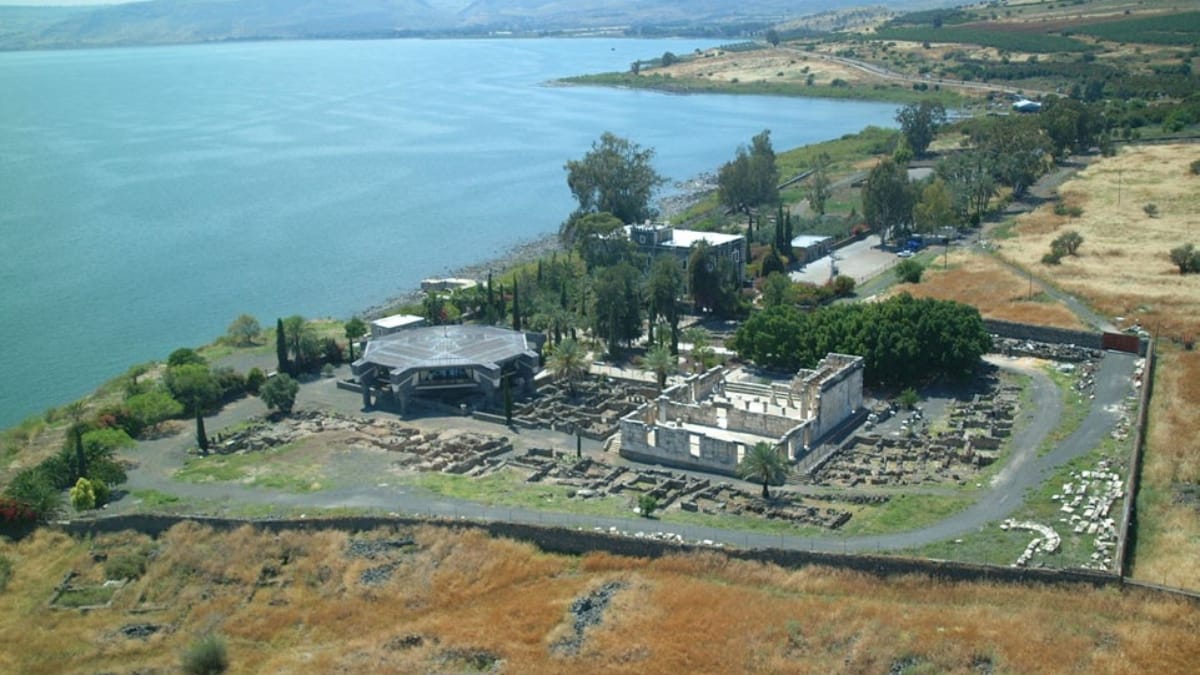
He called Simon and Andrew, who were brothers, and James and John, who were also brothers, all four of them fishermen who fished the Sea of Galilee and lived in or near Capernaum, which is a working-class seaside village. We have a slide of Capernaum, I think, yes? Yeah, there you go. Take a look at that. So, this is what Capernaum looks like today.
You can kind of imagine what it might have looked like back then. So, we have the village, the houses here and here. These are villages and shops here and here and here. And there were some under here.
This thing looks like a flying saucer here. That's a church. One of the things that bugs me about the Holy Land is like every place where Jesus put his feet, somebody has to build a church, right? So, here you have this flying saucer. This actually is up on Stiltsa, so the houses that were there are still there.
They're under the church. So, for example, Peter's mother-in-law's house. Peter's mother-in-law lived at Capernaum, and we hear about her in the Bible. Her house was like somewhere.
.. underneath there is where that is. So this is the village.
And you can see also, for people who lived here, that you could literally like roll out of bed and throw a rock into the Sea of Galilee. You're right there. Also, the beaches here are not sand, they're rock, and so they would have been parking the boats somewhere along here. This building here is a synagogue.
That one was built, I think, if I remember correctly, like 1 or 200 A.D. So, this is not the building that Jesus was in, but the building that Jesus was in is underneath that one. They actually built it on top of, and you can see, I mean, even the houses and things like that are down lower than this synagogue.
So, there is a synagogue below there, which is where Jesus taught, where He did some of His first healings. That is it. The next picture, which don't put that up just yet, but the next picture will be taken from, I believe, right around here. There's a gate right there into the city, and I think the person taking this next picture was standing there.
If you would put up the next. This is the mountain where it's believed that Jesus taught Jesus. the Sermon on the Mount. And again, because Jesus was there, there's a little tiny chapel on top of the hill, so you have to have one of those.
But it's believed that He would have been teaching here and people would just be sitting around on this hillside listening to Him talk. How cool is that? So that's sort of, this is where we are. So back to the disciples. When Jesus called these fishermen, he also gave them nicknames sometimes.
So Simon became Peter, which means the rock. And James and John became the sons of thunder. And he had a way of making friends with people right off the bat, seeing who they were, joking around with them, putting them at ease. And I think Jesus would have been fun to hang out with.
So as we come to the Sermon on the Mount, pardon me, Jesus might not have called all Yeah. 12 disciples at this point. He called them from different towns and different places as he traveled. So at this point in the Sermon on the Mount, we know that there were at least four disciples.
More beyond that, we don't know. Also thus far in Jesus' ministry, he has been staying within the region around the Sea of Galilee, preaching in the synagogues. So, He had not gone south to Jerusalem yet. There are lots and lots of little villages and towns all around the edge of the Sea of Galilee, as well as on the hills beyond the shorelines.
So there would have been lots of synagogues to visit. And also, the word synagogue in Hebrew means to gather together and to gather together. So it wouldn't even necessarily have been a building. It's just a place where people got together that he would have preached, okay? And that's still true today, by the way.
Wherever God's people gather, that's the church, no matter where you are. So Jesus was traveling around, preaching in the synagogues. And many of the sermons that he preached were received really well, like the one that he preached at Capernaum. Some of the sermons were not received well, like the one that he preached in his hometown of Nazareth, where the congregation very nearly threw him off a cliff.
That's another story for another day. So here we are, now gathered on this hillside, looking out over the Sea of Galilee, listening to the Sermon on the Mount. And Jesus has already spoken what we call the Beatitudes, the blessings, blessed are the poor, blessed are those who hunger. I believe that, did Pastor Dylan preach on that last week, maybe? No, okay.
That comes right before today's reading, so I'm kind of, anyway. But all those blessings come right, we've led up to this. Today's sermon, the same sermon, but further along, Jesus changes gears, right? And he says to the people listening, and to us as well, you are the salt of the earth. But if salt has lost its taste, how can its saltiness be restored? Now, I don't know about you, but I have heard a lot of sermons in my lifetime on that particular verse that, And most of the time, the focus I've heard has been on the fact that salt is a preservative.
Salt keeps food from going bad, especially in a warm region like ancient Israel. And likewise, people of faith help keep society from going bad. And there's some truth to that thought. But as I look at what Jesus is saying here, I'm not sure that was his point.
So I went back to the original Greek just to double-check, and as it turns out, there actually But, are two meanings for the word salty in Greek, neither one of them having to do with preservatives. One is salty like the flavor, as in salt makes food taste good. The other is salty as in being on point, like hitting the nail on the head, and that's That was a salty moment, for example. And so both meanings of the word salt tell us that God has made us and blessed us to be a blessing, even if it means being a little salty sometimes.
And I came across a wonderful example of this in real life this past week. I think most of us have been at least somewhat following the story from Minnesota about that little boy Liam in the bunny hat. When I heard that the judge in Texas had handed down a decision in his case, he said, I got nebby, and I went out on the internet and found the actual judge's order, okay? Wanted to see exactly what he said, and you guys are welcome to see this afterwards if you want to, but what I'm interested in here is the very end, because at the end of a judge's decision, you usually have the judge's signature, and that's it, right? But that's not what he ended with. He put on this a little picture of Liam here, and then two Scripture verses, Matthew 19, Right? 14, and John 11, 35.
And he didn't spell out those verses. He just left them there. That's salty. So I, of course, had to be nebbier and go out and find out exactly what those verses said.
Matthew 19:14 says, Let the little children come to me, and do not stop them, for it is But... such of these as the kingdom of heaven belongs.
And then John 11:35, Jesus wept. That's what it means to be the salt of the earth, to direct people's attention to God's word and God's truth and God's love in the way that we live out our lives every day. And along those same lines, Jesus continues his sermon by saying, 'You are the light of the world. Let your light shine before others.
' We don't light a lamp and put it under a bushel. We put it up where it can be seen, and so other things can be seen by that light.' So when Jesus says that this gives glory to God, again, there are two possible meanings in that phrase, giving glory to God. One means praising God, and then second means to speak God's truth.
One theologian put it this way, God made us to spice things up. not to overpower the dish, but to enliven it, highlighting other colors. And likewise, God makes us to shine as only we can. So we do good things like putting food in the food pantry, not because we want to be blessed, but because we are blessed, and we are blessed to be a blessing.
Jesus then counterbalances all of this with a word of wisdom. He says, Don't think I'm doing away with the law and the prophets. Everything in the Old Testament still stands. Every word of it is there to be fulfilled.
and And with this in mind, think back to the Old Testament reading from Isaiah we heard a moment ago. Isaiah writes, Is this not the fast that I choose? - See? To loose the bonds of injustice, to undo the thongs of the yoke, to let the oppressed go free, and to break every yoke. Is it not to share your bread with the hungry and bring the homeless poor into your house, and when you see the naked to cover them and not hide yourself from your own kin? And God promises when we hear and do these things— that our ancient ruins will be rebuilt, that we shall raise up the foundations of many generations, that we shall be called repairer of the breach, restorer of streets to live in. And I just want to say, apart from the sermon, that has always touched me as someone living in Pittsburgh.
because of how the mills went down and the towns went down. We are called to be restorers of these places, rebuilders of these places in the name of God. I've always believed that. These words of Isaiah were written 500 years before Jesus was born, but they are so fresh and so relevant the ink could still be wet.
And isn't that really what we want to see, is to see restoration around us, both for ourselves and for the generations to come. In the Sermon on the Mount, Jesus says that God gives us hope for this. Jesus says everything in the Old Testament stands right down to the last comma or period the Old Testament stands. But Jesus challenges us to do better.
He says, And That could be a little scary thought right there. But Jesus had some specific issues with the scribes and the Pharisees. The scribes were people whose full-time job it was, whose career it was, to copy the Scriptures. They had no printing presses back then, so everything had to be copied by hand onto scrolls And, made out of either sheepskin or papyrus, and they had to be copied absolutely exactly so that God's Word was not changed in any way.
So it's understandable that the scribes became perfectionists. They were by nature nitpickers, which is a great thing for the job, but it was not so good when dealing with people. And the Pharisees, they were legalists. Okay.
They were people who knew the Scriptures very well, and they knew God's law very well, and they held everybody else to the letter of the law, but not themselves. And Jesus said they were like whitewashed tombs, looking good on the outside, but on the inside they were full of greed and self-indulgence and wickedness. And Jesus looks at all this, and he says that his people— His followers, His disciples, need to do better than that. In these words, both from Isaiah and from Matthew, we catch a glimpse of who the real Jesus was.
We also see and hear the hope that God offers us of a future where God's word and God's plans are fully and completely lived out. But we also realize that human beings can't manage that on our own. We need a Savior, and that's why Jesus came. Jesus shows us by words and actions how very much God loves us.
and Jesus has come to us where we are as one of us so that one day we can be where he is. So in the name of Jesus and by his power, be salt, be light, and give God the glory. Amen.