Fairhaven Sermon 1-4-2026
Summary
In this week’s service at Fairhaven United Methodist Church, led by Pastor Rev. Dylan Parson, the sermon drew a profound connection between the Epiphany story of the Magi and the quiet, often overlooked moments where God’s presence is revealed. Rev. Parson began by reflecting on his own childhood experience of witnessing the 2003 solar transit of Mercury—a rare, nearly invisible event that required deliberate preparation and a willingness to seek out the extraordinary. He contrasted this with the Magi’s journey, who, though outsiders to Jewish tradition, were actively watching the heavens and recognized the significance of a "star at its rising." The sermon emphasized that salvation, like Mercury’s transit, is often hidden in plain sight—visible only to those who are attentive and courageous enough to pursue it, even when the religious or political establishment (like Herod’s court) remains indifferent.
Rev. Parson challenged the congregation to examine their own "Jerusalem"—the comforts, routines, or even religious knowledge that might keep them from actually encountering God’s work in the world. The Magi, despite their foreign faith and "wrong" methods (astrology), were the ones who traveled to Bethlehem, worshipped, and let their encounter with Christ transform their lives—even refusing Herod’s demands afterward. The sermon concluded with a call to action: "Are you looking?" God, Rev. Parson argued, hangs "stars" over our lives—moments of grace in overlooked places, among marginalized people, or in the movements of history that demand our attention. Like the Magi, we must step up to the lens, step out of our palaces (whether literal or metaphorical), and let God’s light lead us home—even if it means walking a path we didn’t expect. The service ended with the reminder that Epiphany isn’t just about recognizing God’s presence; it’s about being changed by it.
Transcript
Looking back, I'm not sure how my dad persuaded me to do this, but I got up three or four hours before I normally would on a school day, and I was in third grade. This was a Wednesday morning at the beginning of May, and it was cold. We forget how cold May and June can be, but it was cold. And I threw on my jacket, I threw on a pair of socks that would soon be soaked in the dew, and we headed to the Slippery Rock University quad, the Science Quad, boarded by the Science Building, the Library, and the Dining Hall.
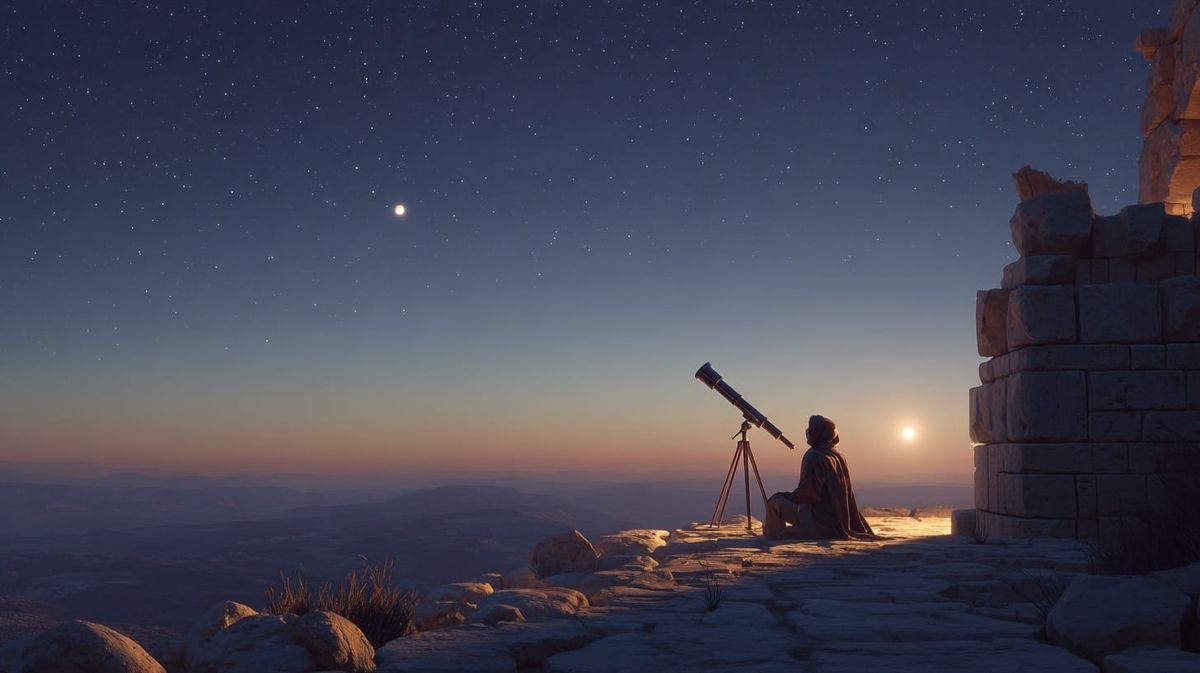
And we were going to go see a rare astronomical event that I did not understand at all. And that was the 2003 solar transit of Mercury, which I'm sure none of you remember. I had a telescope that was mine, a telescope of my own, a red one I'd gotten for Christmas that year. But my parents' house is surrounded by woods on three sides, including to the east, where I would need a clear line of sight to be able to view the star at its rising, so to speak.
And realistically, we'd also need some professional help. First of all, we are planning to look straight at the rising sun, which is not something you want to do through a regular telescope if you want to keep your eyeballs. And second, Mercury is tiny, right? The smallest planet. It's not at all easy to find, and as it passed over the sun, it would be a tiny speck.
Just one one hundred and sixtieth the diameter of the sun. So we got there to the university about twenty minutes before sunrise. And after patiently sitting through an explanation of what we were going to see, we waited our turn to look through the university's big telescopes, much larger than mine at home, as big around as a coffee can, these reflector scopes with a solar filter made of mylar on the end. The material they make helium balloons out of also is a great solar filter if you ever want to look at the sun through binoculars or whatever.
And these telescopes were amazing, just so much better than mine. They were beeping, ticking, humming. They were the automatic ones that track things in the sky. And I finally got to get to my turn to look up at the telescope, and we saw what we'd come to see, which was either entirely underwhelming or amazing, depending on your point of view.
If you weren't interested in it, whatever, right? It's just a dot on the sun. Okay. It's next to unnoticeable, even if you have the best equipment. It's like the opposite of a show-stopping solar eclipse that you have to stop and look and see what's going on.
You have to want to see this. But if you do...
It's miraculous. Because that tiny little rocky planet had aligned perfectly in the sky between me and the sun, 55 million miles away, and it had this little teeny sharp shadow. rising against the sun and traveling over it for the next couple hours. And so over the next hour, I would peek through that telescope periodically as Mercury made its way, and then I put on some dry socks and I went to school.
And it was a really fascinating experience, and maybe because it's such an obscure occurrence. You have to really be looking. You have to want to see this happening. You have to painstakingly calculate the paths of the Earth, the Sun, and the planets, And if you even want to know when it's going to happen, and then you have to have the right tools to see it.
No one had ever seen this in the history of humanity before. Until 1631, you know, 1600 years after the Magi, after the telescope was invented. And obviously this had been happening for millions and millions and millions of years, but no one ever knew. And since then, barely anybody's seen it because who has the equipment, who has the interests to go see this miraculous thing? But I got to see it because I'd heard about it.
I knew who could help me see it, and I got up well before the sun when the opportunity arose to go see this thing. Right. So this Epiphany Sunday, as we hear the story of the three wise men, I think about that morning. Our traditions, our songs for the season tend to focus on the three men, though we don't know there's three of them, as wealthy kings that are bringing expensive gifts from afar to Jesus.
The most important part about them is that they are simply people who have been paying attention. The Magi aren't kings at all, despite the song. The Magi are an educated class in the Parthian Empire, which is centered on Persia, hundreds of miles to Judea's east. They're across the desert.
And they're kind of high-tech pagans. They're this fusion of scientists and priests. Before science was invented, science and religion were kind of rolled together. And they were priests of an ancient religion called Zoroastrianism.
It's got a lot of similarities with Christianity. And they're not hanging out in royal palaces. Again, they're not kings. They're not comfortable.
They're not content. They're not apathetic like King Herod. No, these are active seekers of what God is doing. While the rest of the world is sleeping through the early hours of some Wednesday morning, while the political and religious leaders in Jerusalem are fixated on their own interests, these outsiders, they're not Jews, they're not even Judeans, are out getting their socks wet in the morning dew.
They're looking for this tiny movement in the massive sky. and they have been searching, they have been waiting for a star at its rising, which is a better way to translate a star in the east, a star at its rising. This event has been promised for generations to Israel, and yet it would be nearly invisible to anyone who's not already looking for it, watching the movement of the heavens and of history to see it finally happen. And so when it comes, when this star shows up in the sky, the magi are ready.
They notice, and they know, as scientists often do, the delicate workings of God's creation. And so they know where are celestial objects supposed to be? When are they supposed to be there? And so whenever something new shows up, it sticks out in a way that it wouldn't if you weren't watching. It defies the orderly, cyclical nature of the skies. You know, usually the stars, the planets travel in very predictable patterns.
You can predict them thousands of years in the future. That's why Stonehenge still lines up with the solstice and everything. But this star doesn't line up with anything because it's different. It's new.
It's unpredictable. And that makes it special. Of course it would signify something unprecedented happening. And so they follow it.
They head a thousand miles west to Jerusalem. And when they get to Jerusalem, these foreign dignitaries, they seek out the king's court. If a new king is being born, after all, you would think that the one to know about it would be the current king. Not Herod.
The Magi tell him, We saw his star at its rising, the new king of the Jews. Not Herod. They announce that they've come to bow down before this newborn king. And even though it's likely taken the Magi weeks or more to arrive, this is a long distance again.
After they saw that star, they got on horseback, they traveled across the entire Middle East from edge to edge. This is all news to him. Nobody around Herod has noticed the star. But these guys had noticed.
Those who were supposed to have been looking for it all along are completely unaware. And we find that Herod is troubled at this news. That's the word that is used here, troubled. And an extra troubling element here, too, again, is the origin of these magi.
These guys are Persians. They're not just Gentiles. They're enemy Gentiles. They're representatives of this empire that is Rome's chief rival.
It'd be like if a Soviet delegation showed up in D.C. in the height of the Cold War and asked the president about something going on in Missouri and he hadn't heard about it. That's a major national security threat.
And what's more, this ruler Herod, who publicly identifies as a faithful Jew, which he has to be if he's going to be king here, he's got to endear himself to his people, he's supposed to know this stuff, but he has to ask. He has to ask the priests and the legal experts about the prophecy the Magi are referring to. He has no idea what they're talking about. What star? What messiah? And this is striking.
We find that Herod is troubled, but Matthew tells us that everyone in Jerusalem was troubled with him. The star means the Messiah was born. That's what it's supposed to mean. And the prophet Micah says that Bethlehem will give birth to one who governs, one who will shepherd my people Israel, as the priests report to Herod.
But the people are upset about it. They're troubled that this might potentially come to pass. You would think they'd be thrilled the Messiah is here. But they like things the way that they are when it gets down to it.
Even if they don't say it, that's what their actions reveal. Sure, Herod's not a great king. He's not particularly righteous. He likes to massacre people.
He's kind of oppressive. But if you stick on the right side of Herod, you're in good shape. But, But the Messiah, who knows what to expect, he's going to rule with justice, the prophets say. And justice might be a little destabilizing.
And yet, even after the Magi bring Herod's attention to the birth of the Christ, it is striking how lazy he is. Herod remains alongside the entire political and religious establishment. You would think if someone came to tell you, hey, I've traveled a thousand miles to go see this newborn king, that he might go see him himself. This is a major threat.
Herod acknowledges that it's a major threat. He's very worried about it, but he doesn't even get up. Matthew's Gospel indicates again that all of Jerusalem has been made aware of this star. This leaks out fast.
Everybody's troubled. But apparently no one feels compelled to actually go check it out, except for the Magi. And I don't know if you know your biblical geography very well, so I looked it up to make sure. So Herod's scribes pull out the prophet's writings.
They point to a map. They say, oh, this guy's going to be born in Bethlehem. They know the precise coordinates of what God is doing. And yet they refuse to move.
They don't go. Why? Well, I don't think it's only laziness. They're falling into a trap that's built into religion that threatens all of us. They have the perfect theology.
They have all the knowledge they need. They have the correct rituals. But they are much more interested in knowing about God than knowing God. About God, but not meeting him face to face.
They're content to know about the Messiah, to be right about the Messiah, to know all the prophecies without ever actually taking the opportunity to meet the guy when he shows up. A map and a Bible are safe to hold. They don't threaten you. A Messiah who's alive might change your life a little bit.
And so they settle for the correct answer for the knowledge they have in Jerusalem. They stay safe in their heads and their books rather than risking their hearts by traveling to Bethlehem. And again, here's that geographical piece. You might think, based on this information, that it would be a real trek for them to get to Bethlehem.
Maybe it's really far. Maybe that's why Herod doesn't get on the road and go. No. Bethlehem is six miles away.
six miles they would have to travel. They could walk it in a day, but they stay home. The Magi, on the other hand, actually start walking. They follow the star, it reappears over Bethlehem, and they get going.
And the people that the Messiah has come to who have been awaiting his coming for generations are either just ambivalent or hostile. Their faith and theology are right. They understand it in their heads, but they are completely captive to their own inertia. It is these priests from a different religion, a pagan religion, from a country across the whole wide desert, who insist upon going to bow down before this kid.
What's six more miles when you've already walked a thousand? And it's important to understand again just how outrageous it is that the Magi are the ones going. These are Gentiles and not just any Gentiles. They practice astrology. They practice fortune-telling.
All this stuff is forbidden for Jews. And not only that, these are also exactly the tools that have brought them to the Messiah. They're doing things they're not supposed to do, and God still used it to pull them towards Jesus. And so it's them who goes.
They set off from Jerusalem. They're guided straight to Joseph and Mary's house. And so these bold magi arrive at Jesus' home, and they are there to do nothing but worship him and bring him gifts. God has picked up a pen to write a new chapter of salvation, and he starts up right where he left off.
At first, long ago, he was working with Israel. God brought Israel to the promised land, first through Abraham, a wanderer from over there by Persia. And then he led them out of the exodus in Egypt into Israel. And finally brings his people back from exile in Babylon, again, right by Persia.
And now it is foreigners who come from this foreign land where the people were once exiled who have come to meet God face to face in a way that those who should know better don't want to do. For the first time in history, Jerusalem doesn't get it, but Babylon gets it. Jerusalem, the faithful people of God don't really know what God's doing, but these Babylonian Gentiles know that there's something that has to be sought out here. For centuries, the road to the east was a one-way road that you traveled when you were defeated.
This was the road of captives, of people who were displaced and exiled. You had to travel over to Babylon, to Persia, when you were being dragged away in chains from everything you loved. But now, that same road has taken on a completely new meaning. John the Baptist would proclaim in the years to come, using the promises of Isaiah, this road made clear in the desert.
And the flow of this traffic has reversed. And Babylon is no longer the destination of the prisoner, it's the source of people who are pilgrims, who are seekers, who are looking for God. And these people who generations before burned Jerusalem to the ground are now the ones who come to worship the king. It's this really scandalous reversal, this homecoming.
And I think it suggests that exile doesn't end once Israel gets its borders back set up right, once they're secure, once they have their own king. The exile is reversed only whenever the enemy finds their way home too. Right? And this star really points to a new thing unfolding. And it's no coincidence that those who are far away saw it before the people up close.
God used the Magi's wrong religion to lead them to the right king. And when the Magi finally arrive at this house in Bethlehem, they don't just drop their presents and walk away. Matthew tells us they fall to their knees and honor Jesus. And this is the hinge of the whole story here, this worship.
These pagans who had spent months tracking stars, thousands of miles walking through the dust, they finally find the source of the light and they're going to stand in it for a while. And notice too what happens next because they meet him and they change. After the Magi find Jesus, their plans are turned upside down. Their entire course of action is altered.
They were probably sincere about going back to Herod. They promised him they'd go back, they'd tell him what they found. But once they knelt before Jesus, something changed. Once you meet the king of kings, you lose the ability to take orders from a troubled tyrant king.
And so they refused to participate in Herod's schemes. And his schemes are going to rapidly turn towards the massacre of all these innocent children that could threaten his kingship. They're not going back. It is the Magi's worship of the king that makes obedience to this false king impossible.
Okay. They're only going to have one king. And this reminds us that epiphany, which just means seeing God, has a cost for us. If we meet God, if we encounter the word made flesh, we then just can't go back and serve the empires, the tyrants, the kings.
the falsehoods of this world. You can't follow the one who is going to rule and govern with justice and then stay on the good side of Herod. Think about those religious experts in Jerusalem, too. They had the knowledge.
They had the books. They had the religious credibility. And so they knew exactly where the incarnation of Jesus was going to happen. They had the map.
but the Magi are the ones that take the journey. We can be like that. We can know all the right words and information. We can study the Bible for decades and know it inside and out, quote it.
We can know all about Jesus and, We know right where God is supposed to be, but are we willing to go see him? Jerusalem stayed inside. They weren't interested in taking a six-mile leisurely walk, but those from Babylon walked 1,006 miles. And so the question is given to us, where is salvation being birthed in our world right now? And that answer isn't obvious. The Magi show us that we're not going to find it if we're not looking for it.
It can be shining in the sky, and we won't know. But God hangs stars over our heads and pulls us if we want to go and if we are watching. Think about it, just the sky, right? Do you have any idea what's going on in the night sky yesterday versus tomorrow? Do you have any idea, unless you see some Facebook post about a supermoon or a spot on the evening news about a lunar eclipse? You could have an eclipse every night this week and you wouldn't know unless you were going out looking for it. We are not in the habit of openness, of anticipation, of observing.
On that morning in May at SRU, I saw that tiny little dot on the sun. It was nearly unnoticeable. It was invisible to anyone heading to work or school at that hour. but it changed my Wednesday.
It changed my life's memories because I sought it out. I stepped up to the lens. Salvation happens like that. You gotta look for it.
You gotta step up to the lens on some random Wednesday. It's not gonna be on some fancy, dramatic, holy day every time and see what God is doing. salvation is being birthed among us right now. God's doing things right now.
In neighborhoods we overlook, in people we'd rather avoid, in the movements of grace that are easy to not see at all. And so if we stick around in the comfort of our little palaces, if we stay in the heart of Jerusalem, we're never going to see the stars that call to us about what God is doing. And so the question is, Are you looking? God appears to those who are brave enough to slip out before sunrise, patient enough to wait for the light, and courageous enough then to let the light lead them home on a different path. In the name of the Father, and the Son, and the Holy Spirit.
Amen.